…And Know Your Tests Actually Mean Something
Recently, several articles have suggested that AI may signal the end of traditional unit testing.
- “AI Is Forcing the End of Unit Testing” (Analytics India Magazine)
- “How AI Coding Makes Developers 56% Faster — and 19% Slower” (The New Stack)
- “AI Tools Make Coders More Important, Not Less” (Harvard Business Review)
- “AI-First Testing Is a Dangerous Approach to Code Quality” (HackerNoon)
Some argue AI will replace unit testing.
Others warn that AI-first testing is dangerous.
So which is it?
The answer is simpler:
AI does not end TDD.
It exposes whether you ever understood it.
The Speed Illusion in AI Unit Testing
AI can generate:
- 100 tests in seconds
- Full coverage
- Edge cases
- Happy paths
This feels powerful.
And it is.
But speed is not isolation.
Coverage is not protection.
AI optimizes for plausibility and pattern matching.
Unit testing optimizes for correctness and boundaries.
If you confuse the two, you inflate confidence without increasing quality.
AI Unit Testing Is Not New (We’ve Been Doing It Since 2011)
Automated test generation is not new.
We introduced AI-generated unit tests back in 2011.
Long before LLMs became mainstream.
After more than a decade of real-world use in .NET and C++ systems, some patterns became very clear.
Common Problems in AI Unit Testing
Duplicate Tests Multiply
AI generates variations of the same test:
- Slightly different inputs
- Same behavior being asserted
- No new coverage meaning
Coverage numbers go up.
Signal does not.
Duplicate tests create noise.
And noise hides risk.
Noisy Tests Look Impressive
AI often:
- Asserts too many values
- Verifies internal implementation
- Includes unnecessary setup
- Tests behavior that doesn’t matter
The tests pass.
But they don’t survive refactoring.
A good unit test fails for one reason.
If your suite collapses after a harmless refactor, your tests were coupled not protective.
Stapling Bad Code Into Tests
This is the most dangerous pattern.
AI frequently:
- Uses production logic as reference
- Mirrors the same algorithm in assertions
- Encodes current bugs into tests
The result?
The test “proves” the code works
because it repeats the same logic.
That is not validation. That is duplication.
False confidence is worse than missing tests.
Its too easy
And here’s another uncomfortable truth:
Because writing tests is now easy, developers often just delete failing tests and ask AI to rewrite them.
The test fails.
It’s quicker to regenerate than to investigate.
But when you rewrite a failing test without understanding why it failed, you may be deleting the only thing protecting you.
AI makes rewriting trivial.
It does not make debugging optional.
Where AI Is Actually Excellent
AI shines when:
- Working with legacy code
- Creating a safety net before refactoring
- Exploring untested paths
- Generating scaffolding quickly
For large legacy C++ or .NET systems, this is extremely valuable.
AI can give you a starting point in minutes.
But that starting point must be reviewed.
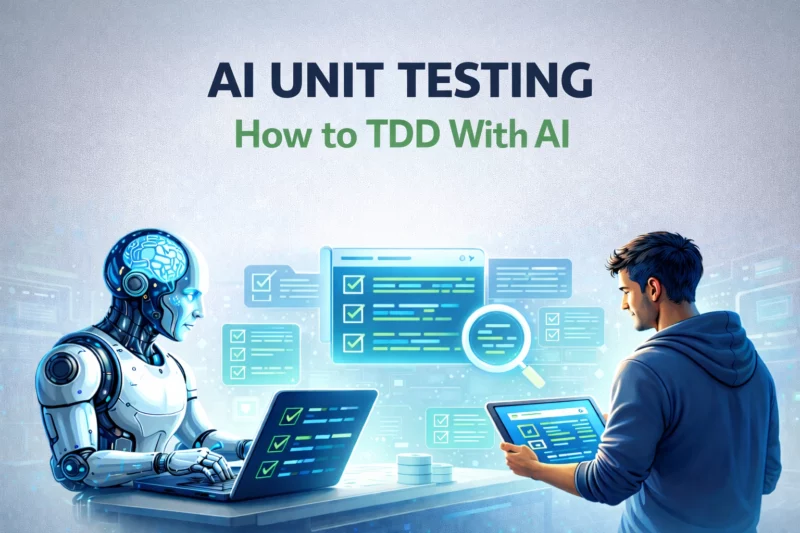
How to TDD With AI (The Practical Way)
Instead of letting AI “write your tests,” use it deliberately.
Here’s a workflow that works.
Step 1: Prompt for Behavior Exploration
Ask AI:
“Find all cases for this behavior.”
“List normal, edge, and failure scenarios.”
This forces thinking about intent before code.
Step 2: Generate Unit Tests Using Seams
Prompt:
“Write unit tests using the seams (a, b, c).
Do not call real infrastructure.
Isolate external dependencies.”
Be explicit. If you don’t define boundaries, AI will happily cross them.
Isolation must be intentional.
Step 3: Implement
Now implement against the tests.
If tests break during simple refactoring, they were tied to implementation details.
Refactor both.
Repeat.
The Developer’s Role Has Shifted
Traditional TDD:
|
1 2 3 4 5 |
Write test See it fail Implement Refactor |
AI-assisted TDD:
|
1 2 3 4 5 6 |
Describe behavior AI generates tests Review (AI) Implements Refactor safely |
As a human you must review carefully:
Are we testing behavior, not implementation?
Is the test isolated?
Does it hit real services?
Are assertions meaningful?
Are there duplicate tests?
You are no longer just writing tests, you are reviewing meaning.
The Real Risk of AI Unit Testing
The real risk (as with all AI) is inflated confidence.
AI increases:
- Test count
- Coverage percentages
- Speed
But it also increases:
- Duplicate tests
- Noisy tests
- Shallow assertions
- Hidden coupling
AI multiplies whatever discipline you already have.
If your testing culture is weak, AI scales weakness.
If your testing culture is strong, AI scales strength.
Final Thought on AI Unit Testing
Writing tests is now easy.
Writing meaningful tests is still rare.
TDD in the AI era is not about typing faster.
It is about:
- Clear behavior definition
- Strong isolation
- Intentional boundaries
- Reviewing what your tests actually prove
AI does not end unit testing. It forces us to do it properly.
Learn more about Continuous Unit Testing in 2026