AI coding agents are getting much better at writing software.
They can understand requirements, modify multiple files, refactor code, generate unit tests, run those tests, and fix failures.
So when we worry about the quality of AI-generated code, there is an increasingly common answer:
Use another AI to check it.
That sounds reasonable.
But there is an important problem.
If one probabilistic system writes the code, writes the tests, and another probabilistic system decides whether those tests look good, we have not created independent verification.
We have created another opinion.
A stronger pattern is beginning to appear across software development:
Let the AI reason. Give it deterministic engineering tools to check its work.
Microsoft is doing this for C++
C++ is difficult for an AI agent to understand from source text alone.
Templates, macros, overloads, headers, compiler settings, and complex type relationships make it easy for an LLM to see only part of the picture.
Microsoft’s approach is interesting because it does not simply ask Copilot to become better at guessing C++ semantics.
Instead, Copilot can use Microsoft’s existing C++ language intelligence.
The C++ Language Server already understands things such as definitions, references, symbols, types, and call relationships.
Microsoft has also been working on Whole Codebase Indexing, which creates a persistent semantic index of symbols and relationships across a C++ project.
The architecture is roughly:
AI Agent
   |
   v
C++ Language Server
   |
   +-- Definitions
   +-- References
   +-- Types
   +-- Call relationships
   +-- Codebase semantics
The AI does the reasoning.
The specialized tool supplies facts.
That distinction matters.
Applitools is doing the same thing for visual testing
Now take a completely different problem.
Suppose an AI coding agent changes a web application.
How should it decide whether the UI still looks correct?
One approach is to take a screenshot, send it to a vision model, and ask:
Does this look right?
Sometimes it will.
Sometimes it will not.
Applitools takes a different approach.
Its agentic testing integrations allow AI agents to invoke a specialized visual-testing engine.
The agent does not need to invent its own visual comparison logic.
The testing system performs the comparison and gives the agent structured results.
Again, the architecture looks familiar:
AI Agent
   |
   v
Visual Testing Engine
   |
   +-- Visual comparison
   +-- Regression detection
   +-- UI differences
   +-- Structured evidence
Once again:
The AI reasons. The tool measures.
Now apply the same idea to unit testing
Imagine an AI coding agent modifies a class and generates eight unit tests.
All eight tests pass.
Great.
But are they actually eight useful tests?
Maybe five execute almost exactly the same behavior.
Maybe several differ only in their input values.
Maybe one accidentally calls the network.
Maybe another writes to the file system.
Maybe the tests depend on global state.
Maybe the mocks or fakes prevent the test from exercising the behavior it claims to test.
The agent can read the tests and form an opinion.
You can even ask another AI:
Are these good unit tests?
It will probably produce a convincing answer.
That is not the same thing as checking them.
Passing tests do not automatically mean good tests
This problem existed long before AI.
Developers have always written duplicate tests, fragile tests, over-mocked tests, and tests that technically pass while providing very little protection against regression.
AI changes the scale.
A developer might write five tests manually.
An AI coding agent can generate fifty.
That makes test generation dramatically cheaper.
It does not make test verification cheaper.
In fact, the faster we generate unit tests, the more important independent test analysis becomes.
Traditional development might look like this:
Developer
   |
writes 5 tests
   |
Human reviews them
Agentic development increasingly looks like this:
AI Agent
   |
writes 50 tests
   |
   ???
That ??? is becoming one of the more important problems in AI-assisted software development.
Don’t ask the AI to guess whether its tests are good
Give it a tool that can check.
A unit test review tool can analyze concrete properties of the tests themselves.
For example:
- Are several tests substantially duplicated?
- Do tests access external resources such as files, networks, or processes?
- Are mocks and fakes being used in suspicious ways?
- Are tests exercising different behaviors or repeatedly checking the same thing?
- Is the test suite becoming larger without becoming stronger?
Then the AI can reason about those results.
That gives us a much better feedback loop:
         AI CODING AGENT
                 |
         writes code + tests
                 |
                 v
       ┌──────────────────┐
       │   TEST REVIEW    │
       │                  │
       │ Duplicate tests  │
       │ External deps    │
       │ Bad fakes        │
       │ Test behavior    │
       └────────┬─────────┘
                |
         structured facts
                |
                v
            AI reasons
            AI fixes
            run again
That is very different from:
AI: I wrote the tests.
AI: I checked the tests.
AI: They look good.
Human: Ship it.
AI checking AI is useful, but it is not verification
Using one AI to critique another can be useful.
LLMs are good at reviewing intent, spotting suspicious patterns, explaining code, and suggesting improvements.
But critique and verification are different jobs.
A compiler does not ask an AI whether the syntax looks valid.
A profiler does not ask whether a method feels slow.
A code coverage engine does not ask whether a line was probably executed.
These tools measure something.
The AI can then reason about that measurement.
The same principle should apply to AI-generated unit tests.
The next generation of AI agents may depend on old-fashioned engineering tools
There has been enormous focus on building smarter models.
That will continue.
But AI coding agents may become far more reliable for a different reason:
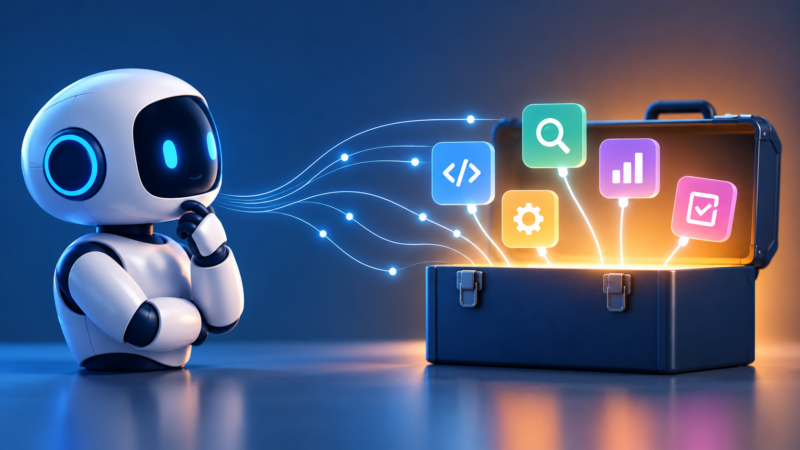
They will get access to better tools.
Compilers.
Language servers.
Static analysis.
Code coverage.
Mutation testing.
Unit test analysis.
Mocking frameworks.
Visual testing.
Profilers.
Build systems.
Security scanners.
An AI agent connected to those systems has something an isolated language model does not:
evidence.
The model does not need to know everything.
It needs to know when to call the right tool.
This is where Typemock Test Review fits
At Typemock, this is one of the ideas behind Test Review.
Test Review analyzes unit tests instead of simply asking an LLM to read them and decide whether they look sensible.
Today, it can detect issues such as duplicate tests, external resource dependencies, and problematic fakes.
The same principle applies whether those tests were written by a developer, generated by Copilot, produced by another coding agent, or created by a mixture of humans and AI.
But AI makes the economics much more interesting.
When an agent can generate dozens of unit tests in seconds, manually reviewing all of them becomes the bottleneck.
So instead of teaching every AI agent to guess whether a test suite is good, give the agent a tool that can inspect it.
The workflow becomes:
Generate → Test → Review → Fix → Repeat
instead of:
Generate → Ask AI if AI did a good job → Hope
Better agents will not just be smarter. They will be better equipped.
Microsoft’s C++ work shows one version of this architecture.
Applitools shows another.
Unit testing should follow the same direction.
AI agents do not need to replace the engineering tools developers have spent decades building.
They should use them.
And as AI writes more production code and more unit tests, that distinction becomes increasingly important.
Don’t teach an AI to guess whether its tests are good.
Give it a tool that can check.